
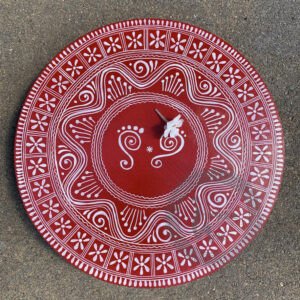
Aipan Art originates from Almora in Uttarakhand, India. This traditional folk art emerged during the rule of the Chand dynasty, a Hindu Rajput lineage that governed the Kumaon region from around the 10th century. Over centuries, Aipan evolved alongside the cultural, social, and spiritual life of the region.
People traditionally practiced Aipan inside their homes rather than in formal studios. Art is created using white rice flour paste, known as biswar, on a red ochre base called geru. The contrast between red and white gives Aipan its striking visual identity. Artists draw the designs by hand, often working directly on floors or walls without sketches.
Aipan motifs reflect a deep connection to nature and daily life. Common symbols include lotuses, footprints of deities, celestial forms, and geometric patterns. These motifs carry specific meanings and relate to prosperity, protection, fertility, and harmony. Many designs draw inspiration from Hindu, Jain, and Buddhist traditions. Together, they blend spiritual intention with visual rhythm.
In Kumaon, Aipan plays an important role in rituals and ceremonies. Families create these patterns in puja rooms and at the entrances of homes. They appear during festivals, weddings, births, and seasonal celebrations. People believe Aipan invites positive energy and wards off negativity. Even when viewed as decoration, the practice strengthens cultural identity.
Women have preserved and passed down Aipan Art for generations. Mothers teach daughters the motifs, symbols, and rituals through observation and practice. This transfer of knowledge keeps the tradition alive within households and communities. Aipan therefore represents both artistic skill and shared memory.
Today, contemporary artists reinterpret Aipan beyond ritual spaces. They explore the form through paintings, murals, textiles, and mixed media. These modern expressions help Aipan reach wider audiences while honouring its origins. The art continues to evolve, yet it remains rooted in the living culture of Kumaon.